martes, 14 de junio de 2011

Alphabet Building | MVRDV | Arquitectura 3d

Alphabet Building by MVRDV
Dutch architects
MVRDV
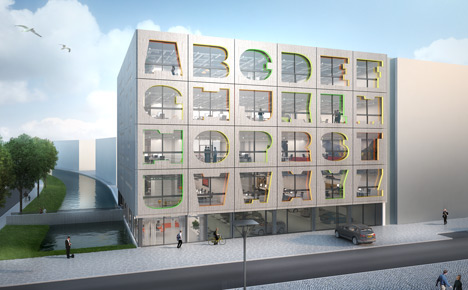
have designed this creative industries office block in
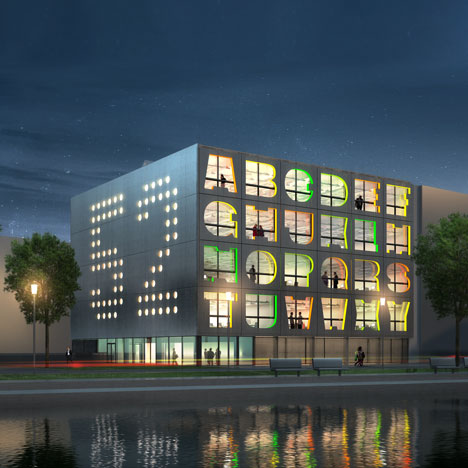
Amsterdam that has letters of the alphabet cut out of the facade.
Alphabet Building by MVRDV
Each cut-out is the window to an office unit and each letter
signifies the address extension for the occupying business.
Alphabet Building by MVRDV
On the east facade of the Alphabet Building a series of
dotted windows spell out the number 52, relating to the address.
Alphabet Building by MVRDV
All letters of the alphabet have been used apart from I and
Q. The original design included Q (as shown in top image) but
was later replaced by Z .
Alphabet Building by MVRDV
The project is scheduled for completion in 2012.
Alphabet Building by MVRDV

More projects by MVRDV on Dezeen »

The following details are from MVRDV:
Alphabet Building Amsterdam
MVRDV designs creative industry hub
Amsterdam based project development corporation NIC started
sale of the MVRDV designed Alphabet building. In Amsterdam small
and mid-size creative companies have trouble finding suitable
office space. The Alphabet building communicates through a clear
exterior design which reveals on the East façade the house
number and at the main façade its extension for each company, a
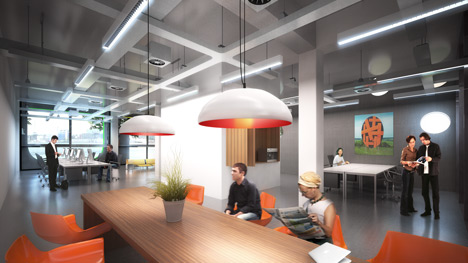
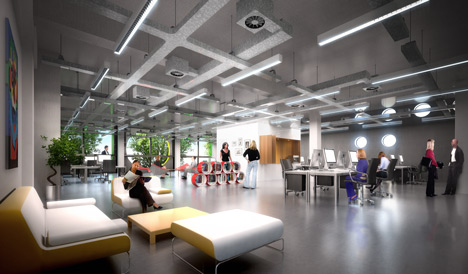
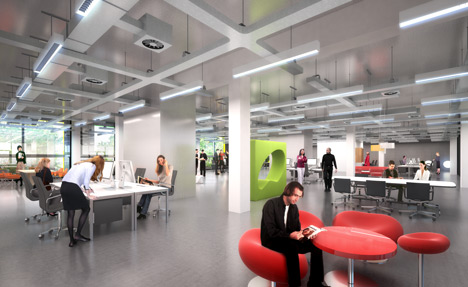
letter of the alphabet. The interior is highly flexible and
completed with a rough and pure finishing. The 3200m2 creative
industry building will be completed in 2012 according to high
energy efficiency standards.
Alphabet Building by MVRDV
  • On the East facade the house number, on the front facade
    its extension.
The creative industry has seemingly unrealistic demands when
it comes to office locations: a incubator of creative ideas
which is spacious and inspiring with a differentiating design at
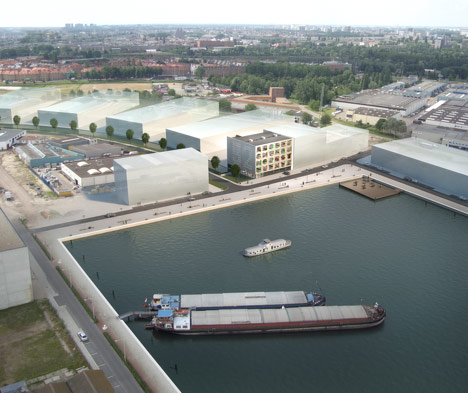
a great location with car access. The Alphabet building in the
Amsterdam port refurbishment Minervahaven unites all these
qualities. The former port is currently refurbished to become a
creative hub.
Alphabet Building by MVRDV
  • Behind each letter is a flexible office unit
The building is on a relatively small site of 30 x 30 meters
and consists of a transparent plinth with a compact office block
on top. Behind each letter of the façade the building offers a
flexible unit of 128m2, the units can be sold independently or
as a series of letters. Design studio Thonik will occupy the top
floor or the letters A to F. As it was impossible to put the
entire alphabet on the façade the letters I and Q are missing:
the IQ is inside the building.
Alphabet Building by MVRDV
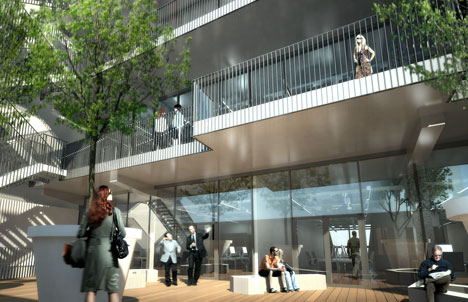
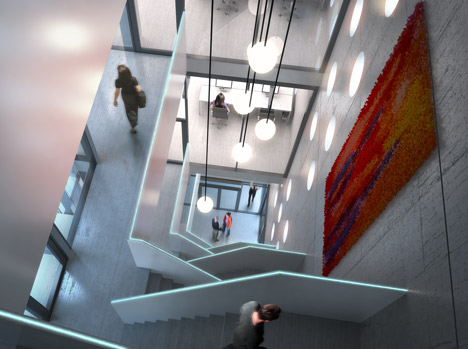
  • Interior finishings are concrete, aluminium and steel
The interior finishing follows the demand of creative
companies, large loft like spaces with a rough finishing: no
double ceilings, exposed materials such as concrete, aluminium
and steel. A number of sustainable technologies give the
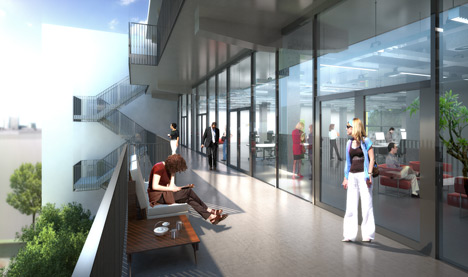
building an excellent energy profile. Parking is located inside
the plinth, circulation and spacious outside areas at the back
of the building.

domingo, 12 de junio de 2011

Cultural Complex Longgang District | Mecanoo | Arquitectura 3d

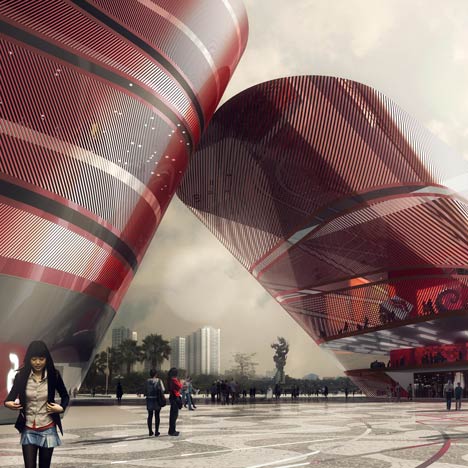
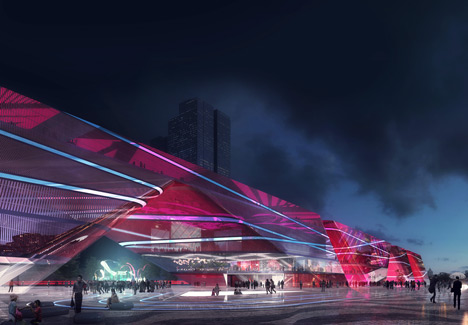
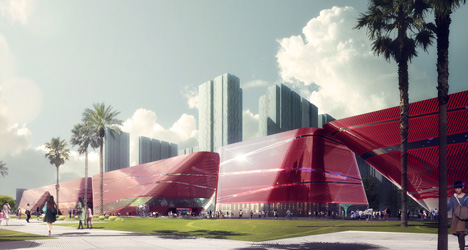
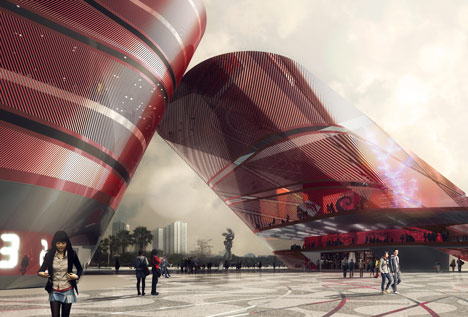
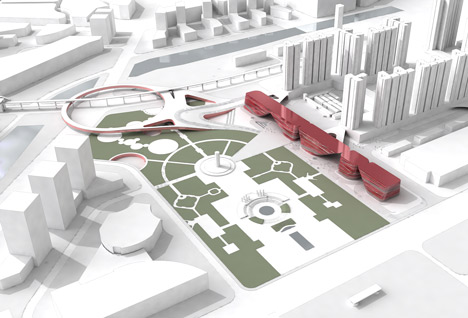
Shenzhen Cultural Centre by Mecanoo
Dutch architects Mecanoo
have won a competition to design a cultural centre in Shenzhen
with this design composed of a row of overhanging red volumes.
Shenzhen Cultural Centre by Mecanoo
The volumes create arches above routes from a new public
square to the business district beyond.
Shenzhen Cultural Centre by Mecanoo
The Cultural Complex Longgang District will contain a public
art museum, a science museum, a youth centre and a bookshop.
Shenzhen Cultural Centre by Mecanoo
Visualisations are by
Doug and
Wolf
.
Shenzhen Cultural Centre by Mecanoo

More projects in Shenzhen on Dezeen »

Shenzhen Cultural Centre by Mecanoo
Here are some more details from the architects:
Cultural Complex Longgang District

Shenzhen, China
Mecanoo designed the winning competition entry for a new
83,500 m2 cultural complex with a public art museum, science
museum, youth centre and a bookshop, public square and parking
in the Shenzhen district. The new cultural and commercial
complex will provide the district with its own landmark and
destination and transform the existing Longcheng park into a
lively destination point. It will form a dynamic link between
the commercial business district, a formal park and gardens and
one of the district’s main thoroughfares. The new museum complex
will unify the evolving urban fabric and generate a vibrant
downtown.
urban connector

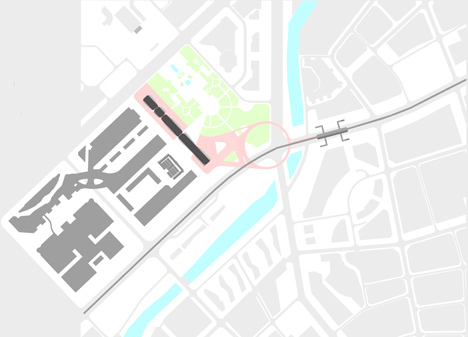
Connecting the cultural complex with the surrounding areas and
new residential development was the key consideration for the
design. The linearity of the existing urban masterplan created a
barrier between the western development area and Longcheng park,
further cutting up the area and contributing to its lack of
urban vitality. Longcheng park will become a lively square which
will further strengthen the quarter’s identity and provide
residents and visitors with a much needed sense of place.
arches

Four building volumes emerge from the ground to create a series
of arches and sheltered public event spaces which frame the
central square. Rounded shapes respect the natural flow of
pedestrians through the site. These open arches serve as filters,
attractors and reference points and allow the building
programmes to expand outside while formally symbolising openness
and connection. Different programmes strategically located on
the ground floor open outwards into the exterior public space
including the city in the exhibition. From within the building
interior, two bridges will link to the commercial plinths of the
new residential area. Cultural and commercial programmes are
linked to contribute to an urban symbiosis.
programme

Cultural complex of 83,500 m2 with public art museum, science
museum, youth centre and a bookshop and 22,500 m2 of underground
parking and a new public square totalling 7 hectares. Invited
design competition, 1st place.

U.S. Embassy in London | Morphosis | Arquitectura 3d

New U.S. Embassy in London


Location: London, United Kingdom
Client: United States State Department
Site Area:4.9 acres / 2.0 hectares
Size:430,557 gross sq ft / 39,999 gross sq m
Program: A consular section including a Grand Hall; a diplomatic area with Glass Dome, Gallery, Multi-purpose room and Main Lobby; and an administrative section with offices, conference rooms, cafeteria, terraces, recreation center and retail. The landscape design presents two new significant public plazas, a consular garden, and a formal courtyard, as well as multiple security measures to safeguard the building and its grounds.
Design:2009 - 2010
Type:Governmental


Project Credits: Morphosis Team
Design Director: Thom Mayne
Principal & Project Manager: Kim Groves
Lead Designer: Chandler Ahrens
Project Designer: Graham Ferrier Elizabeth Wendell
Project Team: Jon Cummings Josh Sprinkling John Carpenter


martes, 22 de febrero de 2011

Strusshamn | Eriksen Skajaa Architects | Arquitectura 3d


Norwegian design team, Eriksen Skajaa Architects urban study for the redevelopment of a former industrial site in Strusshamn, a Norwegian coastal settlement.


Strusshamn is a settlement on the southwest side of Askøy, an island outside of Bergen on the west coast of Norway, with strong ties to the ocean. The fjord was used forntransport due to lack of roads and it was an important economic resource. When this changed and the car became the most important way of communication two centers developed without a clear connection to each other.


The site in Strusshamn is a former boat building factory for Viksund Boats that was bought by the municipality to make a new zoning plan to avoid heavy industry to be established in the future in the old, preserved harbour environment. In our study we are looking for a way to connect the two parts of Strusshamn.

By simple means like improving and defining different surfaces, re-establishing a hidden river, and introducing public spaces of different character we redefine Strusshamn and prepare for the integration of the new development at the Viksund site.

The study examines three different combinations of density and program on the site, but with a similar layout and approach to the site. The layout is based on analysis of climate and landscape with an aim to create good public spaces and buildings with access to light and the spectacular view the landscape offers. A continuous public space with piers, public spaces, a promenade and backyards attach the new development to the rest of Strusshamn.

A central canal on the site connects the two parts of the site together and increases the quality of both and this way not only the houses on the waterfront have access to the qualities of the harbor environment.

Towards the fjord to the south lies a large public space for the whole of Strusshamn.The new development is based on the historical buildings in Strusshamn.

Small volumes that sometimes grow together and create larger units characterize the historical buildings. The buildings are close to the water and create spaces between that vary in size and quality. With those aspects in mind, the new development is a continuation and extension of the historical place, while at the same time demonstrating the possibilities of developing these kinds of sites into areas with more dense or urban structures.


Site Plan Key:

1. Pond
2. Island with duck house
3. Entrance to parking
4. Guest parking
5. Terrain down to sea level
6. Culture ”Boathouse”
7. Water element (Fountain)
8. Canal
9. Bridge
10. Public space on pier
11. Bench
12. Court yard
13. Guest pier
14. House
15. Water element (gutter)
16. Public space
17. Stairs to the sea level
18. House on top of parking base
19. Terrace
20. Vegetable garden
21. Nature park
22. Sculpture park
23. WC and changing rooms for the beach
24. BeachSite Plan Key:

1. Pond
2. Island with duck house
3. Entrance to parking
4. Guest parking
5. Terrain down to sea level
6. Culture ”Boathouse”
7. Water element (Fountain)
8. Canal
9. Bridge
10. Public space on pier
11. Bench
12. Court yard
13. Guest pier
14. House
15. Water element (gutter)
16. Public space
17. Stairs to the sea level
18. House on top of parking base
19. Terrace
20. Vegetable garden
21. Nature park
22. Sculpture park
23. WC and changing rooms for the beach
24. Beach

Whatami | stARTT | Arquitectura 3d

WHATAMI by stARTT
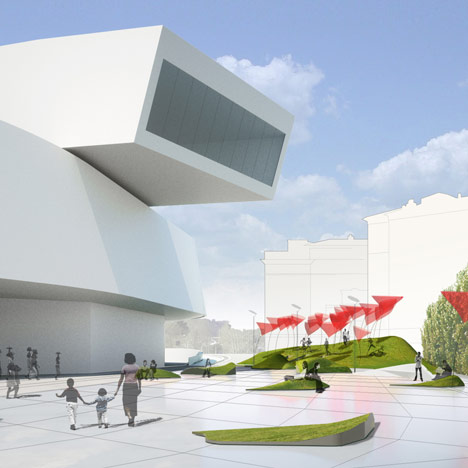
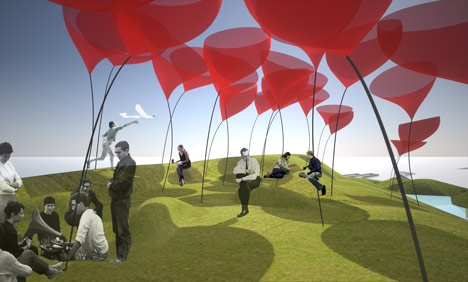
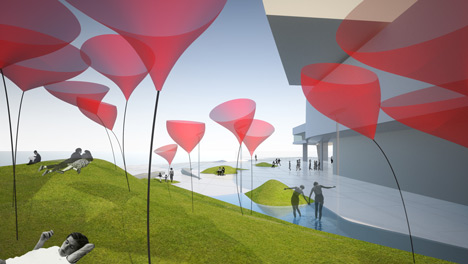
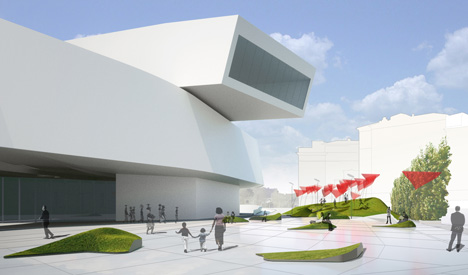
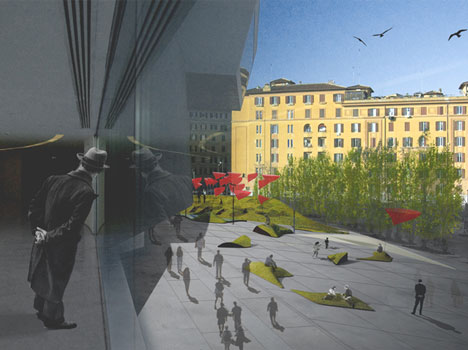
This pavilion by Italian firm stARTT has won the first international edition of the MoMA/P.S.1 Young Architects Program and will be installed outside the Zaha Hadid-designedMAXXI museum in Rome this June. 
WHATAMI by stARTT

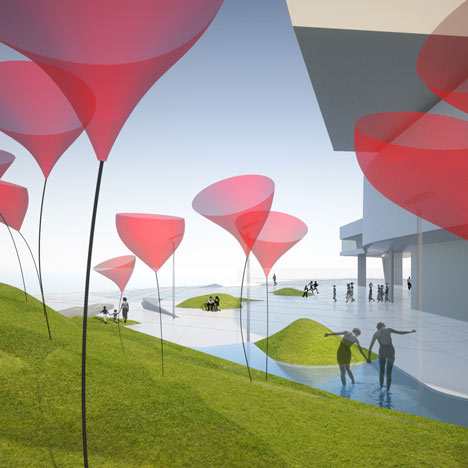
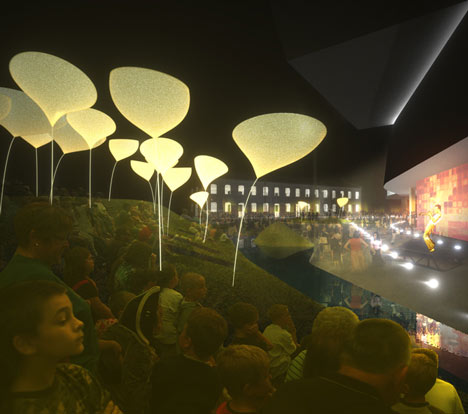
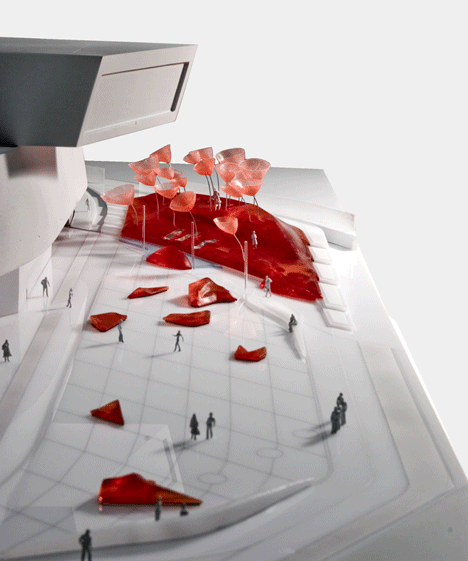
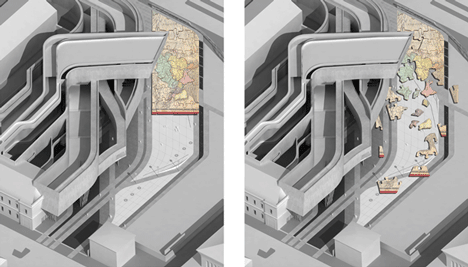
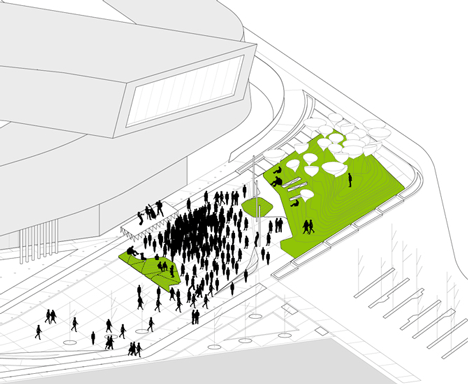
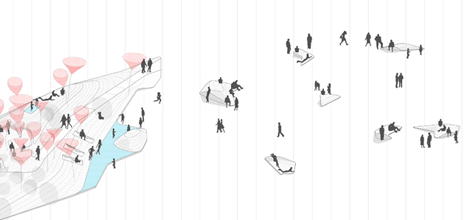
As inaugural winners of the YAP_MAXXI award stARTT’s installation, entitled Whatami, will feature a series of mini hills around the concrete plaza with pools of water in between.
WHATAMI by stARTT

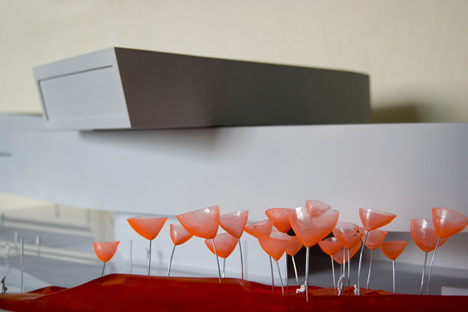
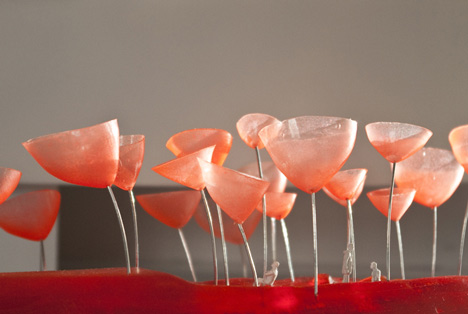
The artificial landscape will be littered with clusters of funnel-shaped canopies representing flowers.
WHATAMI by stARTT

WHATAMI will open in June this year at the same time as Interboro Partner’s winning design for their installation in the courtyard of the P.S.1 Contemporary Art Centre in New York. 
WHATAMI by stARTT

WHATAMI by stARTT

stARTT SELECTED AS WINNER OF THE INAUGURAL YOUNG ARCHITECTS PROGRAM AT THE NATIONAL MUSEUM OF XXI CENTURY ARTS (MAXXI) IN ROME
stARTT’s WHATAMI to open in the Courtyard of MAXXI in June
NEW YORK, February 16, 2011—The Museum of Modern Art, MoMA PS1, and the National Museum of XXI Century Arts of Rome announce Interboro Partners of Brooklyn, NY, as the winner of the 12th annual Young Architects Program in New York, and start, of Rome, as the winner of the first annual YAP_MAXXI Young Architects Program in Rome.
WHATAMI by stARTT

Now in its 12th edition, the Young Architects Program at MoMA and MoMA PS1 has been committed to offering emerging architectural talent the opportunity to design and present innovative projects, challenging each year’s winners to develop highly innovative designs for a temporary, outdoor installation at MoMA PS1 that provides shade, seating, and water. The architects must also work within guidelines that address environmental issues, including sustainability and recycling.
WHATAMI by stARTT

For the first time, MoMA and MoMA PS1 are partnering with another institution, MAXXI in Rome, to create the first international edition of the Young Architects Program. stARTT has been chosen from among five European finalists to create an innovative event space in the MAXXI piazza opening in June.
WHATAMI by stARTT

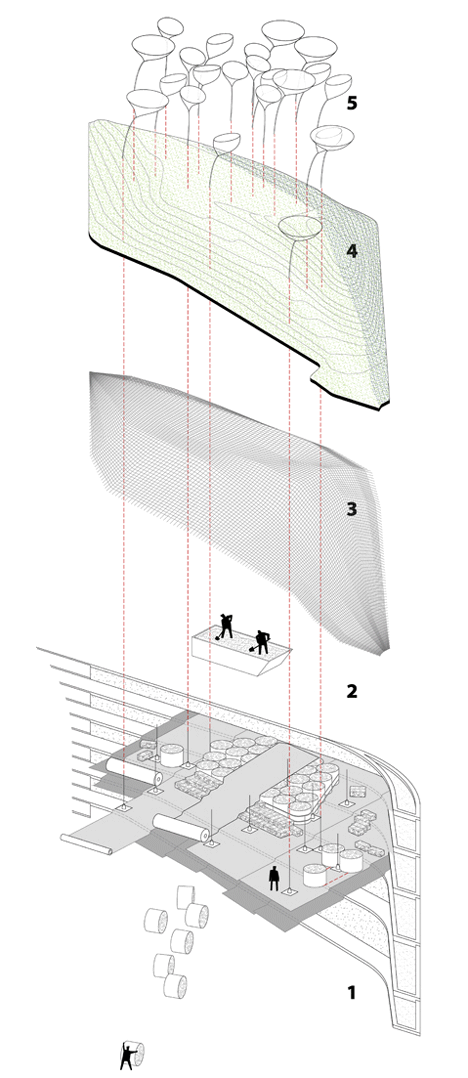
WHATAMI by stARTT is based on the manufacturing of an artificial archipelago-hill, generating smaller green areas in the garden and potentially outside the museum. The hill works as a garden, injecting “green” into the concrete plateau of the museum’s outdoor space, allowing it to serve as a stage and/or parterre for concerts and other events, or as a space to rest and look at the museum itself.
WHATAMI by stARTT

The artificial landscape will be punctuated by large “flowers” providing light, shadow, water, and sound. The materials proposed for the installation involve a two-fold recycling process, the supplying of the materials for the construction (straw, geo-textile, plastic) and the dismantling of the “hill” (turf, lighting).
WHATAMI by stARTT

Opened in May 2010, MAXXI was designed by Zaha Hadid and awarded Royal Institute of British Architect’s (RIBA) Stirling Prize for architecture, and has already gained a place among the elite international contemporary art and architecture museums.
WHATAMI by stARTT


The other YAP_MAXXI finalists were Raffaella De Simone/Valentina Mandalari (Palermo); Ghigos Ideas (Lissone/Mi, Davide Crippa, Barbara Di Prete and Francesco Tosi); Asif Khan (London, United Kingdom); and Langarita Navarro Arquitectos (Madrid, Spain, María Langarita and Víctor Navarro).
WHATAMI by stARTT

Pippo Ciorra, Senior Curator of Architecture at MAXXI, explains, “We’re very happy with the results of this program for three main reasons. First, the collaboration with MoMA proved as effective and productive as we hoped, finally allowing us a surprising insight into the most recent research in terms of architecture, public space, and landscape.
WHATAMI by stARTT

Second, we were able to discover an unexpected positive quality of answers by the Italian and European young (under 35) architects involved in the project, all proposing fascinating, innovative and well developed proposals. Third, we’re delighted that we were able to choose a winning proposal which incorporates a MAXXI_specific approach to the issues of ecology, recycle, and public space.”
WHATAMI by stARTT


Concept Villas | Dubrovnik | Zaha Hadid Architects

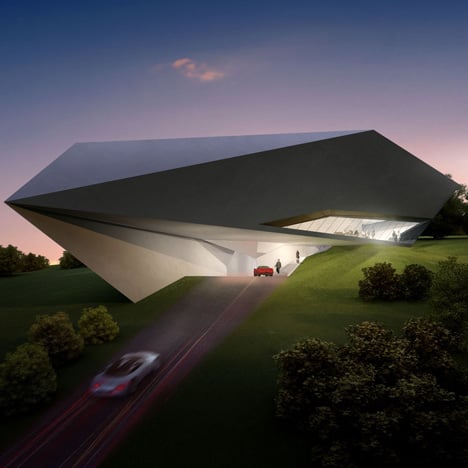
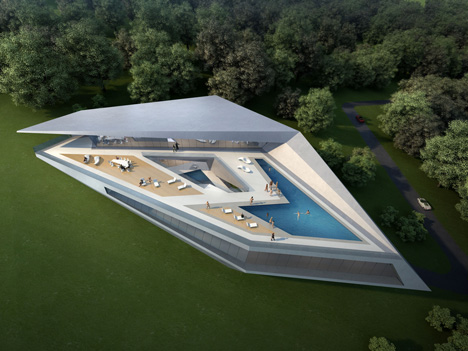
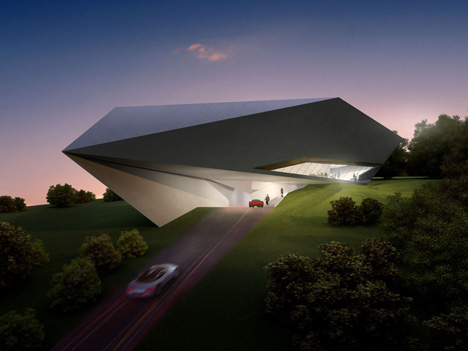
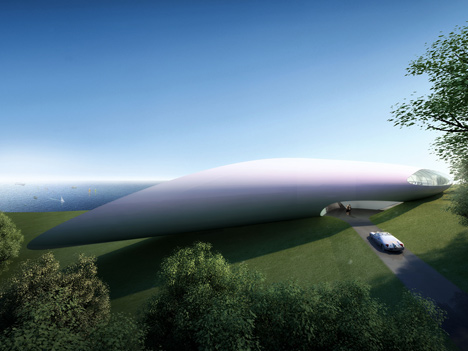
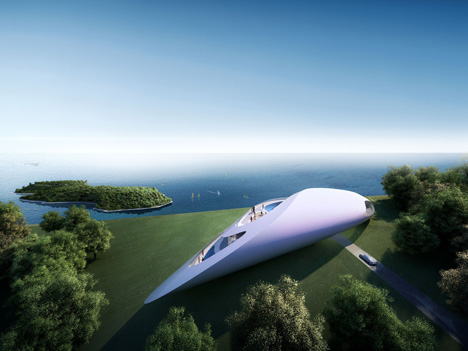
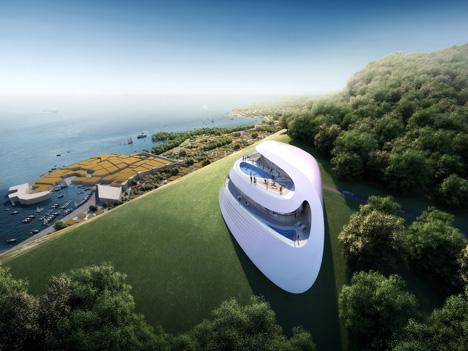
Concept villas for golf and spa resort, Dubrovnik,  by Zaha Hadid Architects 

Prototype villa for golf and spa club, Dubrovnik by Zaha Hadid Architects


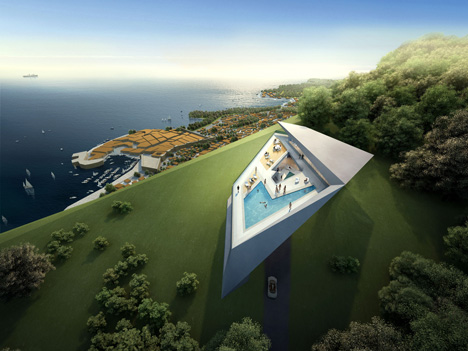
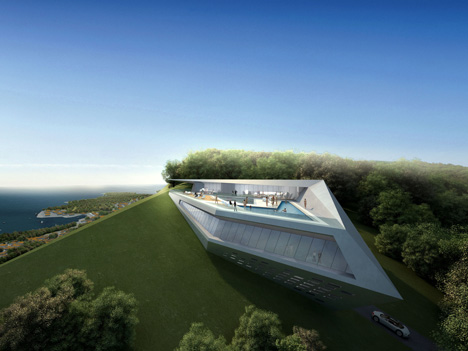
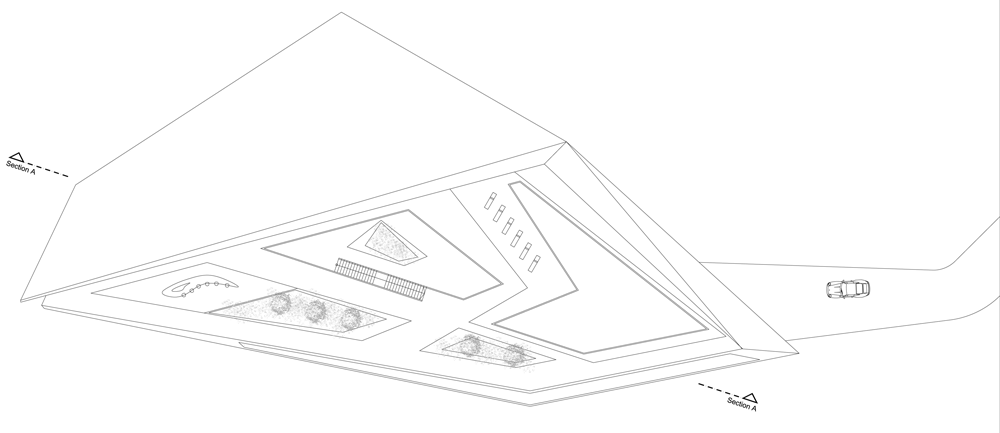
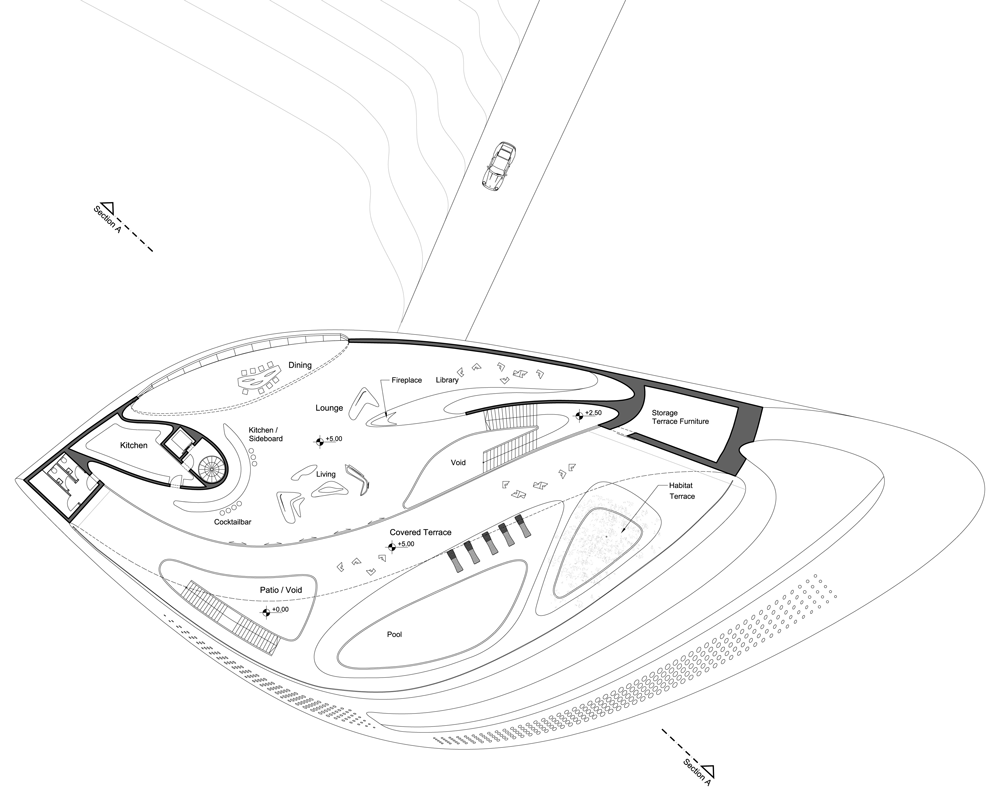
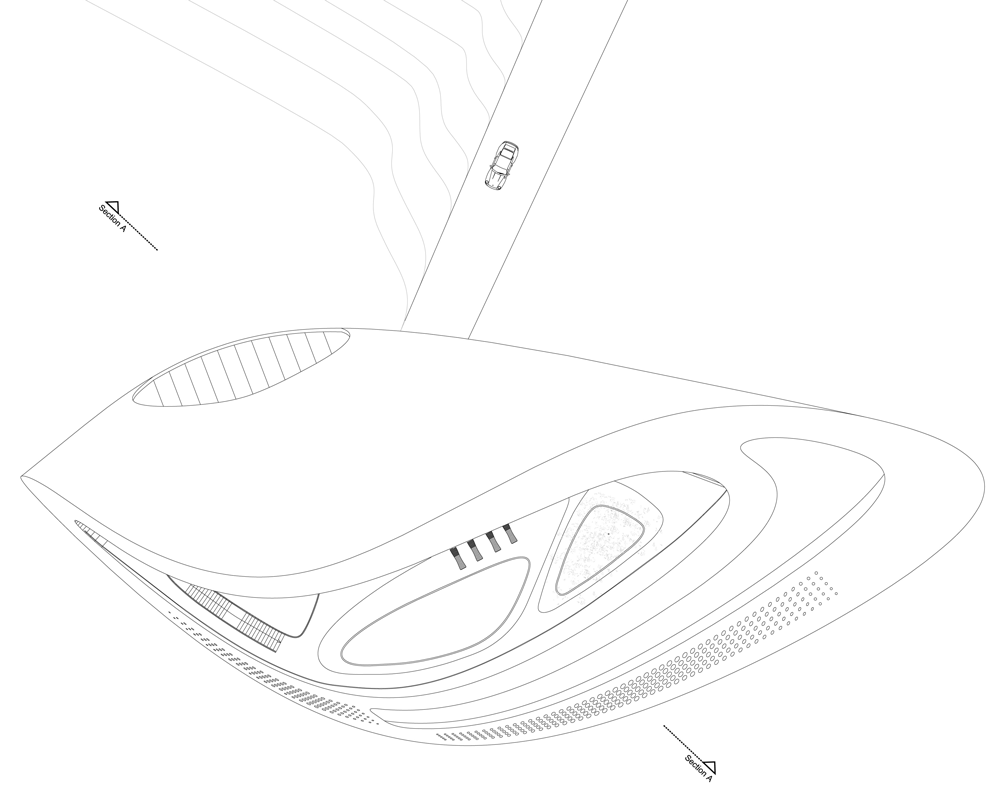
Zaha Hadid Architects have designed two prototype villas a for a site overlooking the historic town of Dubrovnik in Croatia.

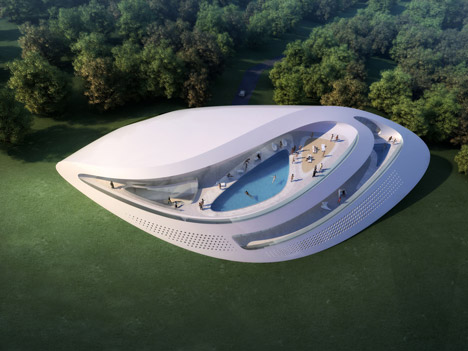
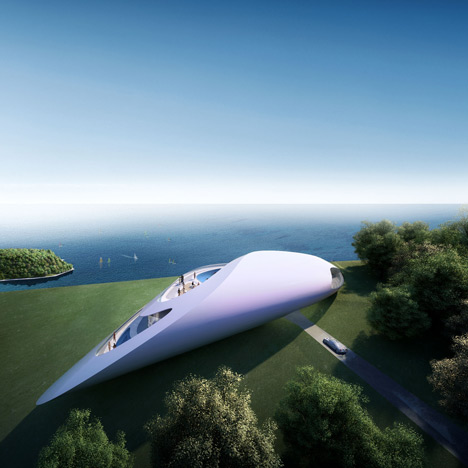
The concepts, named “Rock” (top) and “Shell” (above), have been developed to help define the architectural style of the resort, which will eventually consist of 400 villas plus hotels and a golf course.
Prototype villa for golf and spa club, Dubrovnik by Zaha Hadid Architects
Above: Rock. Below: Shell.
Prototype villa for golf and spa club, Dubrovnik by Zaha Hadid Architects

Concept Design Report
Introduction
The brief called for the design of two prototype Villas for a new Golf and Spa Resort in Croatia overlooking the old town of Dubrovnik. The total development comprises 400 villas, two 5* hotels, luxury apartments, retail facilities, a spa and an 18 hole golf course including a golf resort club house.
Prototype villa for golf and spa club, Dubrovnik by Zaha Hadid Architects
A recently developed master plan determines the perimeter and size of the parcels, which range from 12,000m2 to 20,000m2. The site of the prototype villas is located at the edge of the plateau with picturesque views. The prototype villas shall define the overall architectural design of the resort.
Prototype villa for golf and spa club, Dubrovnik by Zaha Hadid Architects
Site
The area of development is located north of Dubrovnik, a Unesco World Heritage Site. The land comprises 430 hectare and is located on a high plateau approximately 300m to 400m above sea level, north of the old town of Dubrovnik.
Prototype villa for golf and spa club, Dubrovnik by Zaha Hadid Architects
At the southern edge of the project site, the terrain slopes steeply towards the sea. The terrain also slightly slopes from west to east. The elevated level of the site allows for magnificent views in all directions.
Prototype villa for golf and spa club, Dubrovnik by Zaha Hadid Architects
Towards south the owner will enjoy sea views and views of the old town of Dubrovnik. In north direction one can enjoy picturesque mountain and landscape views.
Prototype villa for golf and spa club, Dubrovnik by Zaha Hadid Architects
Design Concept Option Rock
Zaha Hadid Architects architectural proposal is a distinct and unique structure with a strong sense of identity and character.
Prototype villa for golf and spa club, Dubrovnik by Zaha Hadid Architects
It has a highly expressive, sculptural quality, infused with a sense of light and space. Light and views are the driving forces of the house.
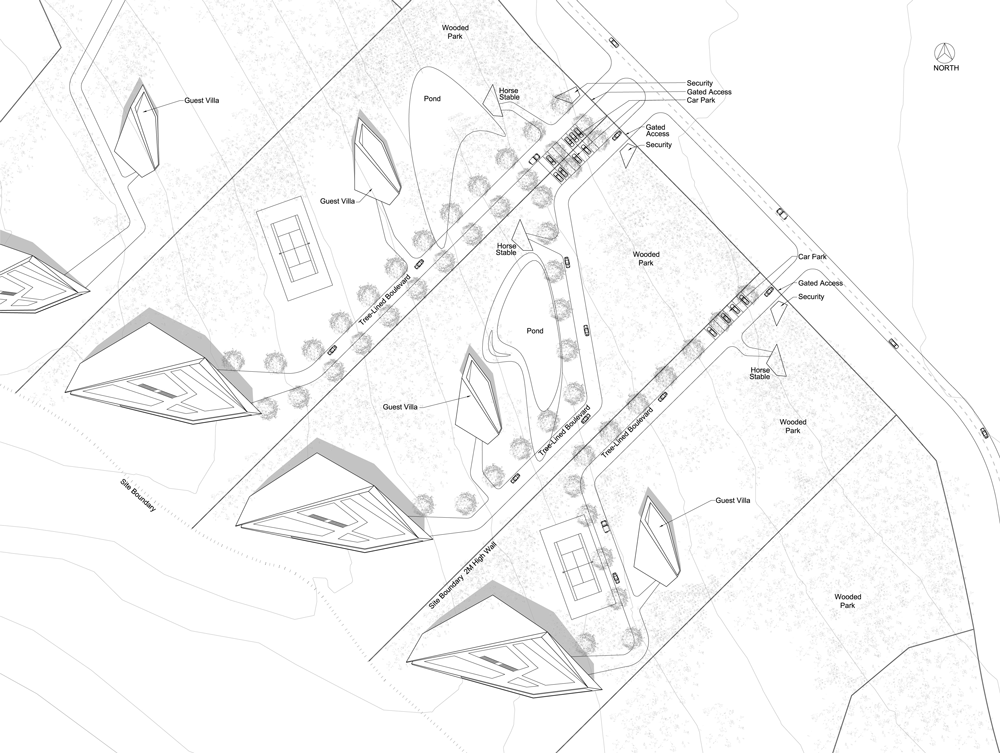
Concept villas for golf and spa resort by Zaha Hadid Architects Rock
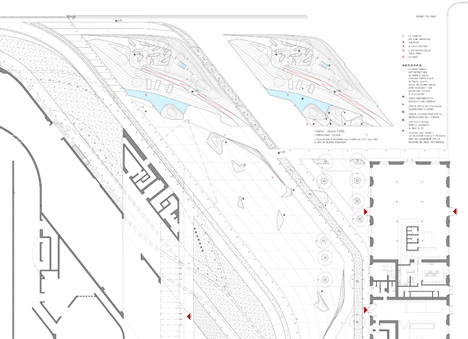
Above: Rock – site plan. Click for larger image
The design is inspired by the Croatian karst topography. Typical karst elements such as sharp-edged cliffs, caves, dolines and sinkholes are adopted by our design.
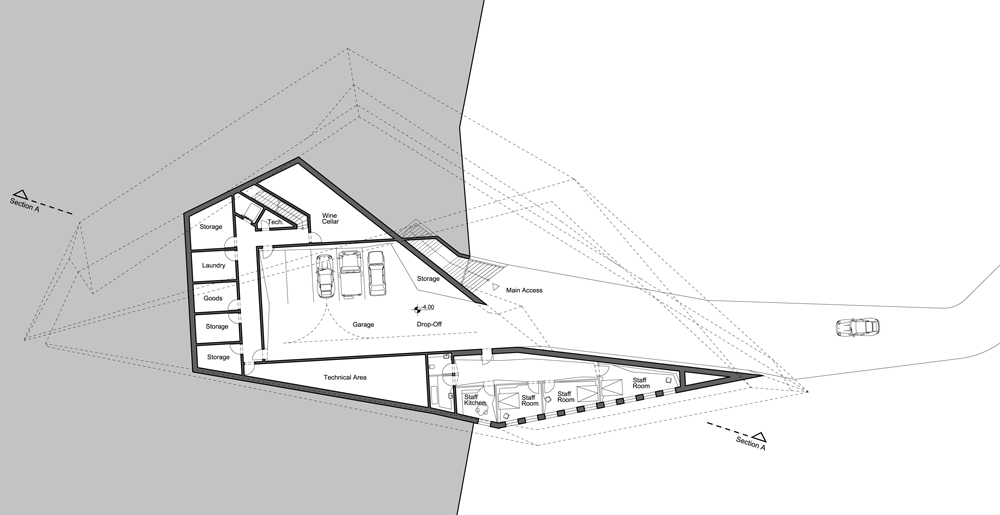
Concept villas for golf and spa resort by Zaha Hadid Architects Rock
Above: Rock – level -1. Click for larger image
Metaphorically speaking, the structure appears like a rock, which is partly sunken into the ground.
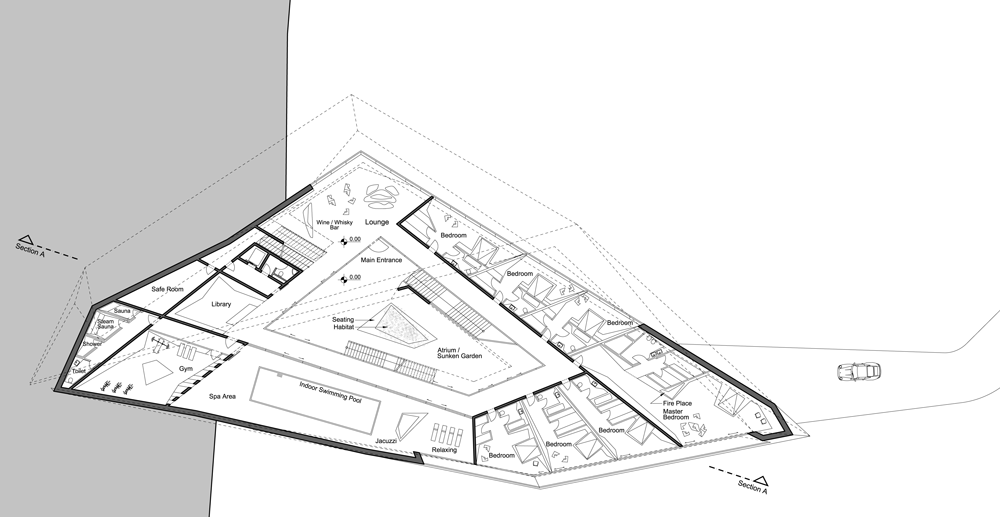
Concept villas for golf and spa resort by Zaha Hadid Architects Rock
Above: Rock – level 0. Click for larger image
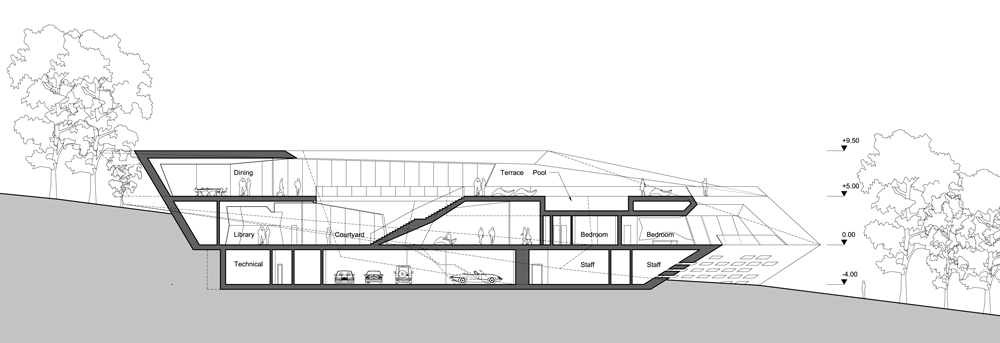
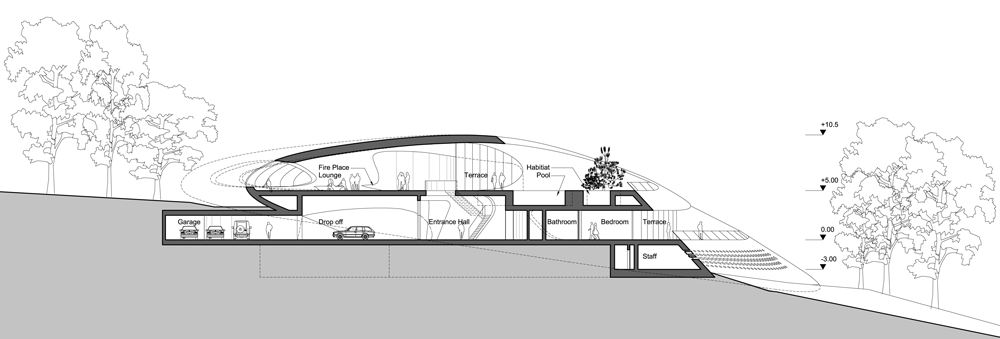
The seven bedroom house is designed as a three-level structure keeping the buildings profile low in sympathy to the surrounding landscaping and the old town of Dubrovnik.
Concept villas for golf and spa resort by Zaha Hadid Architects Rock
Above: Rock – level 1. Click for larger image
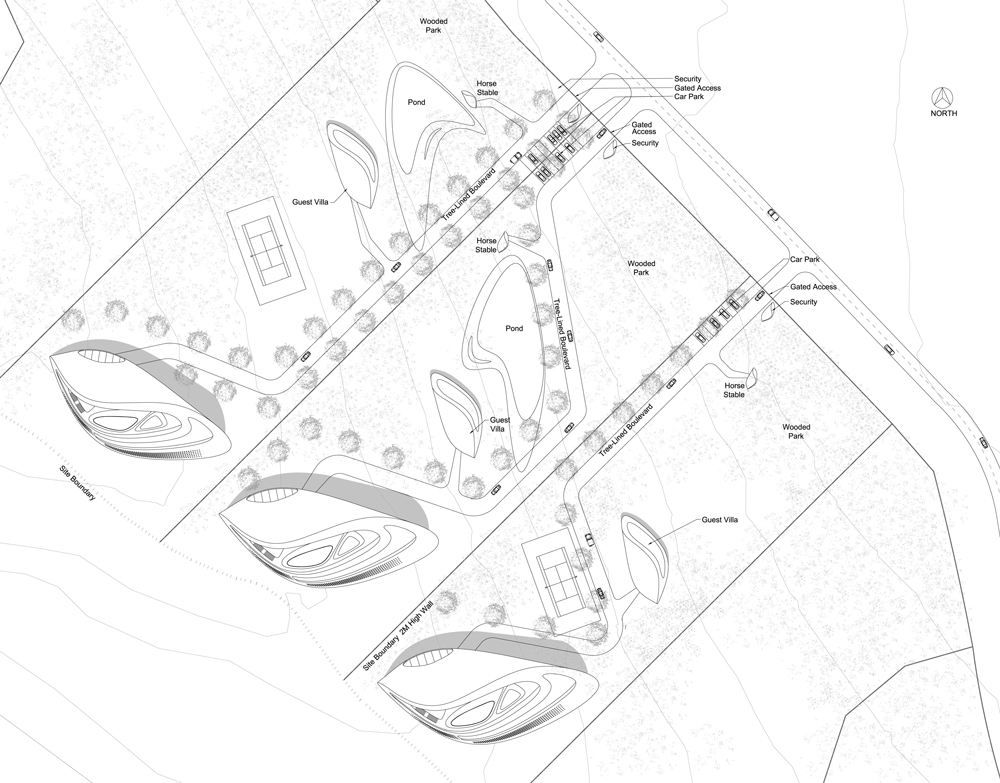
The building is positioned at the very edge of the slope to take full advantage of the views. The park and garden area to the north will be used as recreation area and buffer zone to the existing village and the semi-public road.
Concept villas for golf and spa resort by Zaha Hadid Architects Rock
Above: Rock – roof plan. Click for larger image
Design Concept Option Shell
Zaha Hadid Architects design offers long views internally and engages with the surrounding landscape. The prototype for this luxurious private residence has been developed in response to the programme, the landscape and the views.
Concept villas for golf and spa resort by Zaha Hadid Architects Rock
Above: Rock – section. Click for larger image
The house was designed to be light and spacious with sliding doors giving access to external terraces and courtyards.
Concept villas for golf and spa resort by Zaha Hadid Architects Shell
Above: Shell – site plan. Click for larger image
The private residence elongated curvilinear building shape is inspired by shell structures as they are found along the Croatian Coastline.
Concept villas for golf and spa resort by Zaha Hadid Architects Shell
Above: Shell – level -1. Click for larger image
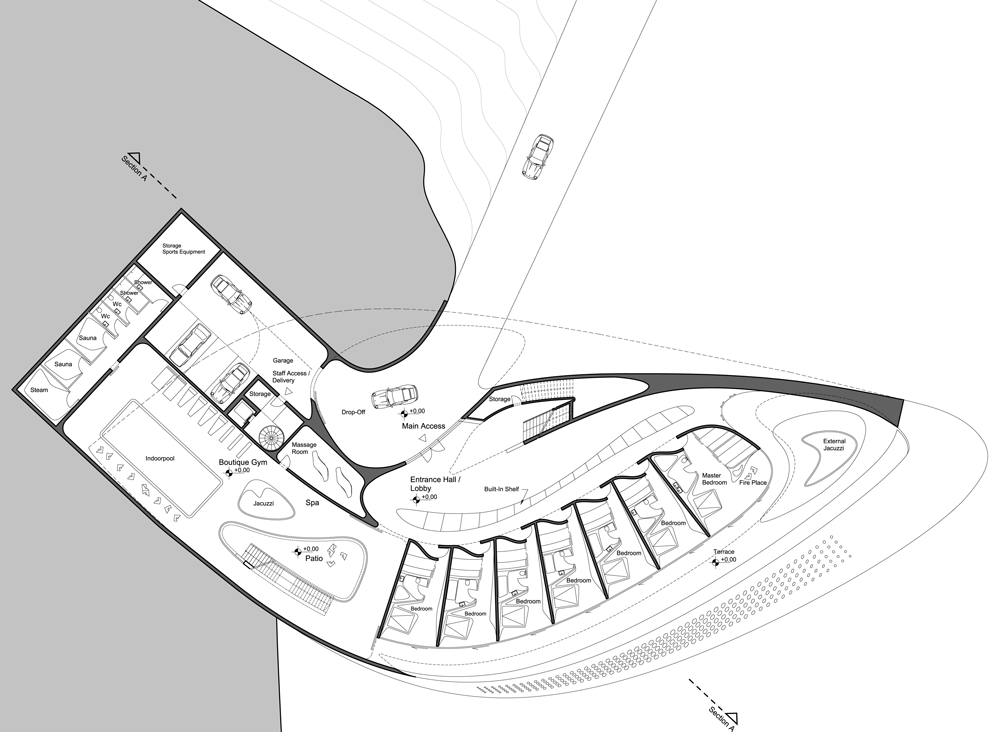
The seven bedroom house is designed as a three-level structure keeping the buildings profile low in sympathy to the surrounding landscaping and the old town of Dubrovnik.
Concept villas for golf and spa resort by Zaha Hadid Architects Shell
Above: Shell – level 0. Click for larger image
The building is positioned at the very edge of the slope to take full advantage of the views. The park and garden area to the north will be used as recreation area and buffer zone to the existing village and the semi-public road.
Concept villas for golf and spa resort by Zaha Hadid Architects Shell
Above: Shell – roof plan. Click for larger image
Golf and Spa Resort Dubrovnik
Location: Croatia, Dubrovnik 2009
Design: Zaha Hadid with Patrik Schumacher
Project Architect: Markus Planteu
Lead Designer: Thomas Mathoy

Concept villas for golf and spa resort by Zaha Hadid Architects Shell
Above: Shell – section. Click for larger image
Project Team: Dennis Brezina, Ivan Ucros, Jesus Garate, Dimitris Akritopoulos, Muthahar Khan
Client: Razvoj Golf
Program: Residential